Leadership
The Society has seven Office Bearers who are unpaid volunteers. They administer the Society and organise our events and duties.
Six of these Office Bearers are elected at the Society Annual General Meeting each year. They are the Moderator, Vice Moderator, Secretary, Treasurer, Surgeon and Custodier. They are joined by the Ex-Moderator who is the most recent past Moderator.
In addition, other members of the Society support the Office Bearers by serving as Convenor of Captains, Honorary Auditor, Honorary Historian, Drill Officer, Deputy Drill Officer and Webmaster.
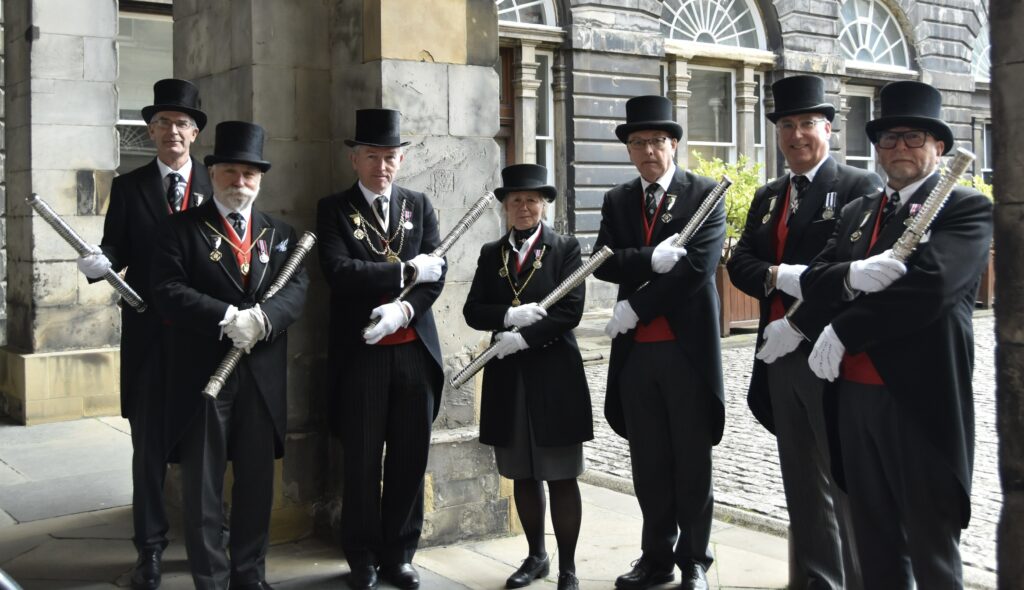
Our 2026-27 Office Bearers: Left to Right: Robert Young (Treasurer), Don Young (Ex-Moderator), Richard Dunbar (Moderator), Kay Linton (Vice Moderator), David Andrew (Surgeon), Andrew Smith (Custodier), Gary Muirhead (Secretary)
History
The Society traces its origins back to 1611, and is therefore one of the oldest civic organisations in Scotland. The first constables were tasked with maintaining order in the City, with their role evolving to become increasingly ceremonial after the creation of a City police force in the 1800s.
1600
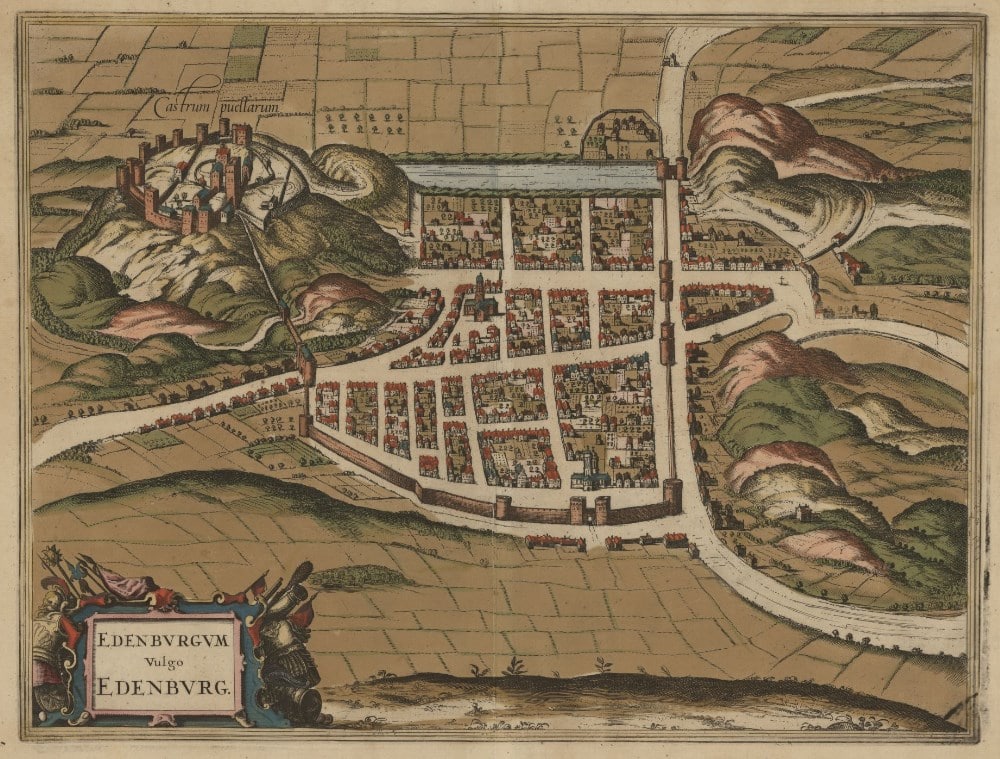
Edenburgum vulgo Edenburg., [Amstelodami] : J. Janssen, ca 1582, published 1657 (National Library of Scotland)
By 1600, Edinburgh had a population of around 15,000 people. A writer of the time described the city thus:
“From the Kings Palace in the east the City rises higher and higher to the west and consists mainly of one broad and very fair street. The rest of the side streets and alleys are poorly built and inhabited by very poor people. And its length from east to west is about a mile while the width of the City from north to south is narrow and cannot be half a mile”.
Edinburgh was the recognised capital of Scotland and as such was the home of the Scottish Parliament.
1611
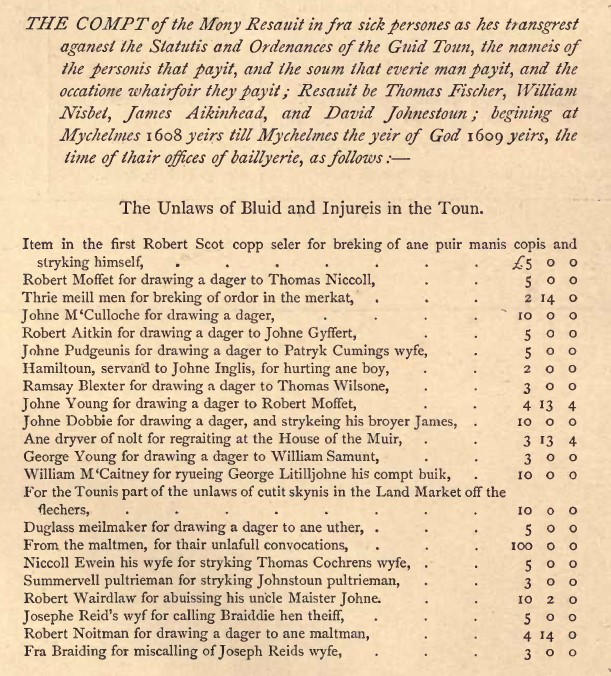
A list of recorded crimes in Edinburgh between Michaelmas 1608 and Michaelmas 1609
Edinburgh was prone to unrest, and there were riots in 1608 and 1611. The King’s Privy Council of Scotland took an active interest in the civil order of the City. In August 1611 they:
“command the magistrates of Edinburgh to appoint some persons to guard their streets and to commit to ward all person found on the streets after the said hour (ten hours bell). If in the taking of them any inconvenient shall happen it is declared that the same shall not be imputed as a crime to the captors but as good and acceptable service”…
After several Edinburgh Town Council meetings, an unspecified number of constables were “elected” on 6th September 1611. Half were merchants and half were craftsmen, and they were expected to enforce 16 regulations relating to such matters as:
“… apprehending suspected persons, apprehend those wearing pistols or dagges, break up affrays at any time of day or night, check bounds and apprehend vagabonds, sturdy beggars or egyptianes”.
1750s
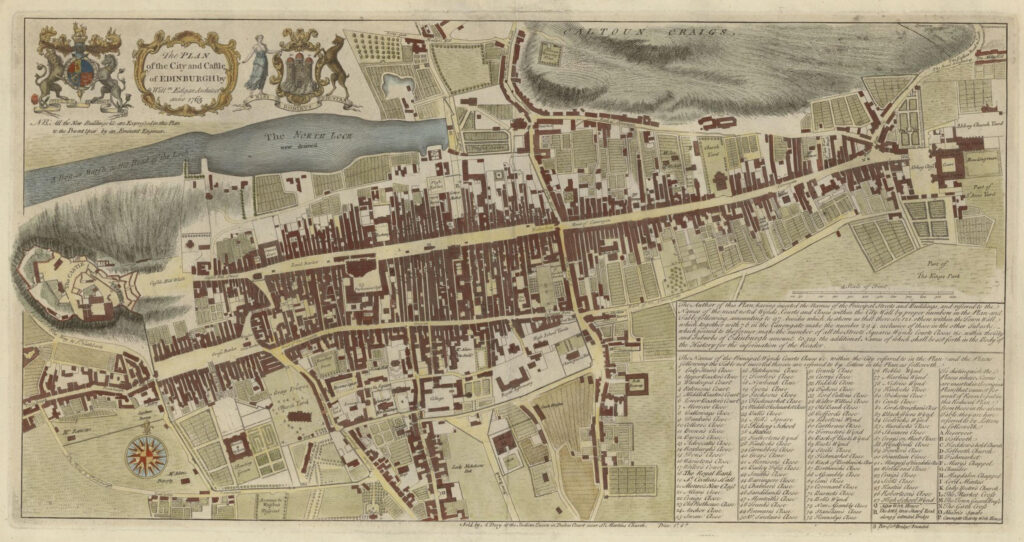
The Plan of the City and Castle of Edinburgh, William Edgar, 1742, reprinted 1765 (National Library of Scotland)
The Edinburgh constables performed various duties through the 17th and 18th centuries, including collecting levies from citizens to pay for street cleaning and engaging the soldiers of the Town Guard, inspecting weights and measures, and assisting in the event of fires or civic unrest.
In 1700 the Council agreed that Edinburgh constables could be armed with short pocket batons, as long as the constables paid for the batons from their fines. The procedure initiated at that time of fining members for non-attendance without a valid excuse and of inspecting constable’s batons when reporting for duty continues to this day.
The first reference to the office of Society Moderator was in 1689. The first recorded serving Moderator was David Grant in 1707.
1805
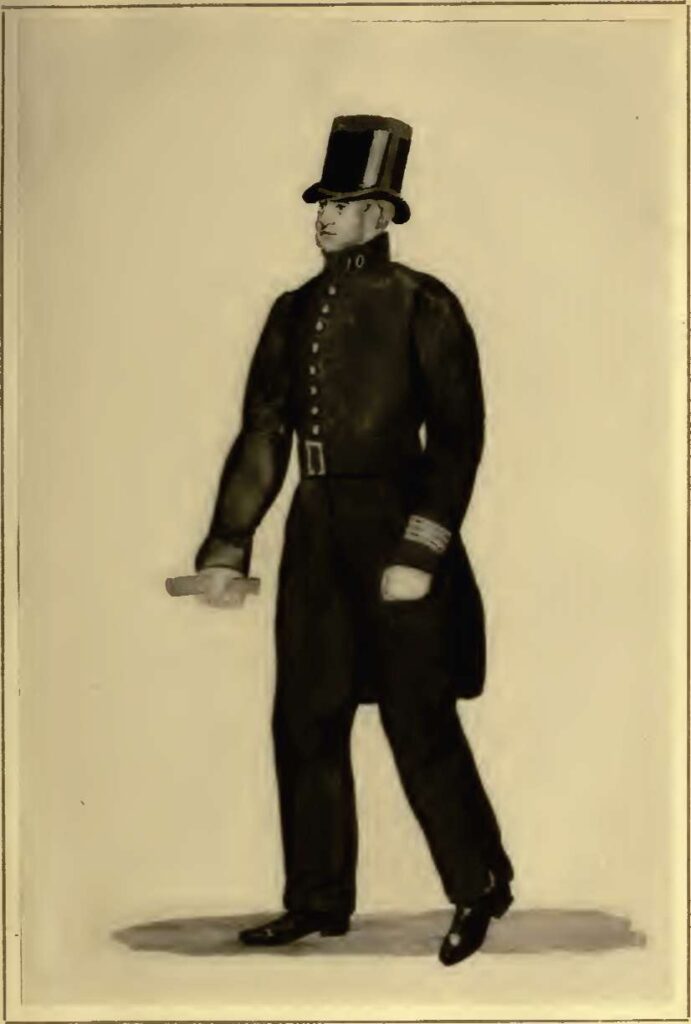
Edinburgh Day Police uniform of the 1840s
The Edinburgh Police Act in 1805 introduced a uniform system of police throughout the whole City. The Society of Edinburgh Constables submitted a petition to the City Council to clarify their relative rights and duties compared to the new police.
The Council responded that, although they wished to retain the valuable support of the Society:
“it was impossible to expect that gentlemen occupying the first stations and most respectable and laborious professional employments in the City, should discharge the duties of watching over the peace of the metropolis”.
The Edinburgh constables would continue, but be subservient to the Chief Magistrate of Police, with the expectation that the police magistrate and his police officers would treat every member of the Society with proper respect.
1810
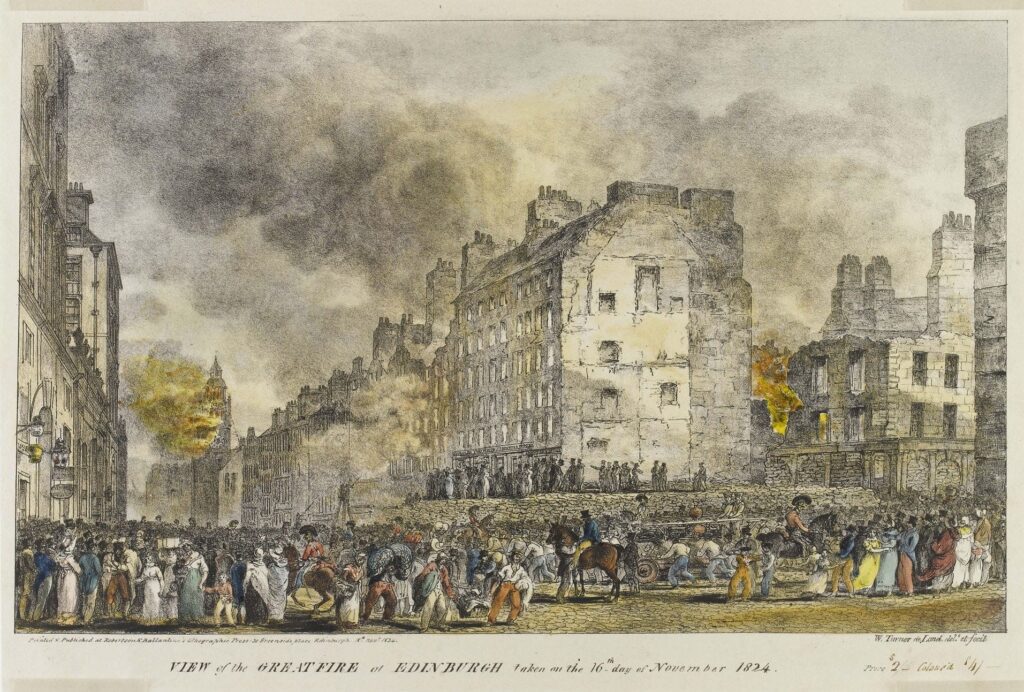
The Great Fire of Edinburgh, November 15th 1824, William Turner (Edinburgh City Libraries Capital Collections)
In 1810, in order to distinguish the Society from the new police force, the Society requested and received permission to use the title “High Constables of the City of Edinburgh”.
The Society of High Constables continued to support the authorities in maintaining order at executions, fires and riots.
The last mention of execution duty in Society histories was for John Dempsey in the High Street in 1820, although in 1828 they were on duty all night at the trials of the infamous body-snatchers Burke and Hare.
On the 12th January 1838 the High Constables were called to restore order following the snowball “riots” involving students at Old College. The large wrought iron gates at the entrance to Old College Quad are still referred to today as the “Snowball Gates”.
1830-1980
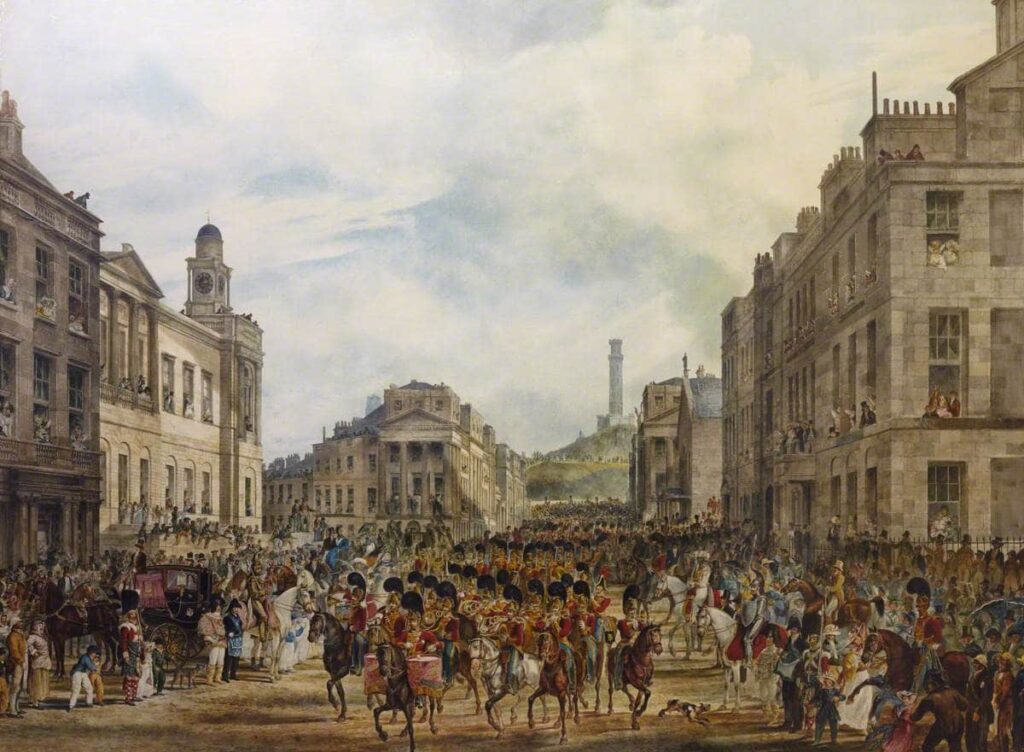
The Procession of George IV Entering Princes Street, Edinburgh, August, 1822, William Turner (Museums & Galleries Edinburgh – City of Edinburgh Council)
The role of the Society of High Constables gradually changed and the attendance on the council on ceremonial occasions became more pronounced.
The Society attended the magistrates and council on the King’s birthday each year, and were on parade at significant events such as the laying of the foundation stones of the Regent Bridge and of the new jail in 1815, at the royal visit of King George IV in 1822 and at the laying of the foundation stone for George IV Bridge in 1827.
The Society also developed a role in raising funds for charity. Sums were collected to support widows and orphans of soldiers killed at Waterloo in 1815, to alleviate famine among workers and their families laid off in Lancashire cotton mills in the 1830s, to fit out wards at the new Edinburgh Royal Infirmary, and many other causes.
In the 20th century, the Society raised large sums to support the war effort in both World Wars and to support the lonely and deprived members of the City community in times of crisis.
1990-2020
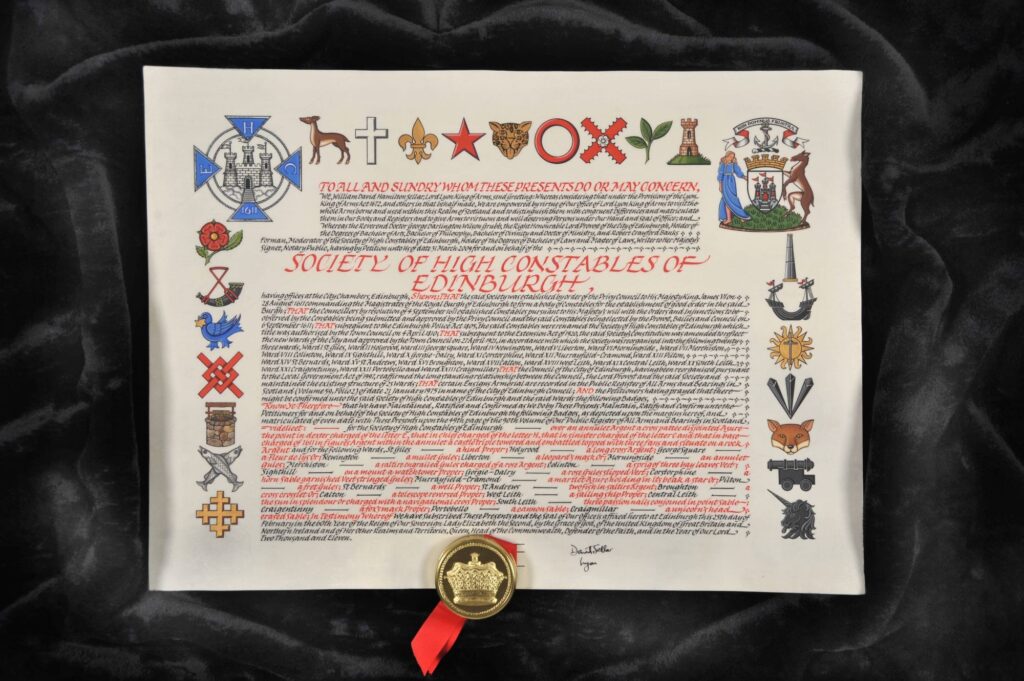
The Letters Patent granted to the Society in 2011, showing the Society Badge, the Badge of the City of Edinburgh Council and the badges of the 23 Society Wards.
The constitution of the Society was modified in 1997 when the members agreed by a two thirds majority to approve the admission of women as members. This was done in consultation with the City of Edinburgh Council. The first female member was elected in October of the following year.
In 2011 the Society celebrated 400 years of serving the City of Edinburgh. To mark this special occasion, Letters Patent were granted by the Lord Lyon King of Arms which formally authorised the use of the Society’s badges. HRH The Princess Royal received the Letters Patent from the Lord Lyon at a reception held for the Society at the Palace of Holyrood House.
Today
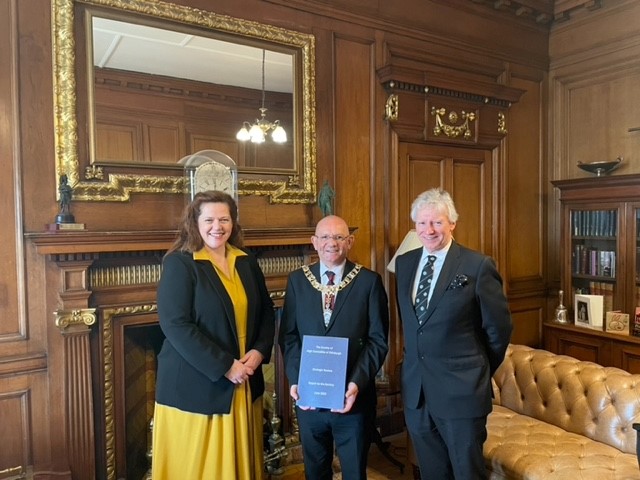
The presentation of the 2023 Strategic Review to the Lord Provost.
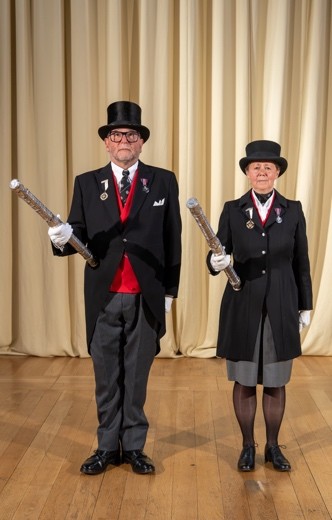
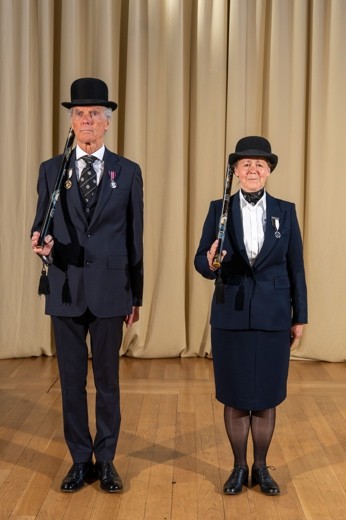
Today the Society attend on the Lord Provost and Councillors of the City on an average of fourteen occasions a year. Many of the duties involve leading parades from the City Chambers to St Giles’ Cathedral. Historic Society silver batons are used by the Office Bearers for these parades. The Society has a close bond with the Council of the City of Edinburgh and forms a valued thread in the rich tapestry of civic life.
In 2023 the Society held a strategic review of its operation and in 2024 it implemented recommendations to help the Society move forward into the future with confidence.
On Duty
We wear Ceremonial Dress for civic duties, or other events as directed by the Society Moderator. We wear Parade Dress for the Spring and Autumn Drill and Inspections.
The uniform is defined in our approved Uniform order which all members must adhere to.
Structure
The Society is made up of 23 Wards, each of 12 constables – a maximum nominal roll of 276 members.
The Society Wards are named and numbered for the City Council electoral wards that existed from 1948 until local government reorganisation in 1975.
Historically, members of the Society needed to be registered electors and live or work in their Ward. This is no longer the case.
The Wards have badges which were formally confirmed by the letters patent granted to the Society in 2011 by the Lord Lyon King of Arms. These badges have links to the Ward locations in the City: they may refer to Ward names, places in the Ward or be taken from the coat of arms of important people who lived there.
Ward I
A hind proper, being the symbol of St Giles, patron saint of the High Kirk of Edinburgh, who rescued a stag from hunters and took an arrow wound in doing so.
Ward II
A long cross Argent, a reference to the meaning of Holy Rood, a Christian relic alleged to be part of the True Cross on which Jesus is believed to have died. The word derives from the Scots “haly ruid” (“holy cross”).
Ward III
A Fleur de Lys Or, taken from the arms of the architect James Brown who oversaw the construction of George Square in the 1760s. This was the first development outside the Old Town and a precursor to the development of the New Town.
The family of Walter Scott moved to George Square in 1774 while he was a baby. In 1792 a mob attacked homes in the area in protest against the Henry Dundas, first Viscount Melville, who was obstructing the abolition of slavery.
Ward IV
A mullet Giles, taken from the arms of Sir James Dick of Prestonfield. He was a 17th/18th century Scottish merchant who served as Lord Provost of Edinburgh from 1679 to 1681. In 1681 he was created first Baronet of Prestonfield, and commissioned the prominent architect Sir William Bruce to design a new house that is now Prestonfield House Hotel.
Ward V
A leopard’s mask Or, taken from the crest of Little (or Littil) of Liberton, a 16th-century Scottish merchant and landowner who served as Lord Provost of Edinburgh in 1586/87 and 1591/92. In 1582 Little was one of the founders of Edinburgh University on the site of the Kirk o’Field Church. His benefaction included the donation of 300 legal books which created the foundation of the Edinburgh University Library.
Ward VI
An annulet Gules to symbolize the bore stone, in which the Royal Standard was last pitched for the muster of the Scottish army on the Borough Muir before leaving for the Battle of Flodden in 1513. The stone is now mounted high on the wall outside the former Morningside Parish Church.
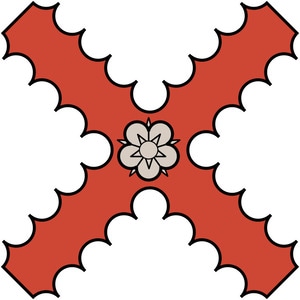
Ward VII
A saltire engrailed Gules charged of a rose Argent, styled after the arms of the Napiers of Merchiston. John Napier, inventor of logarithms and the decimal point, was born in the tower house of Merchiston Castle in 1550. Merchiston Tower was saved from demolition in 1958 and restored as the centre of the Merchiston Campus of Napier University.
Ward VIII
A sprig of three bay leaves Vert from the arms of Foulis of Colinton, a family who served as MPs for Midlothian for many generations from the mid-1500s to the mid-1700s.
Ward IX
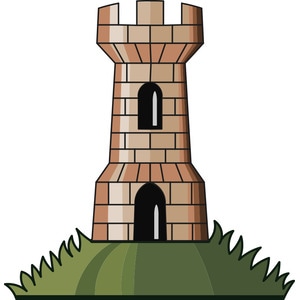
On a mount a watchtower Proper, being a play on words of the ward name. Sighthill is one of the outer areas of the city, being mostly developed after the Second World War.
Ward X
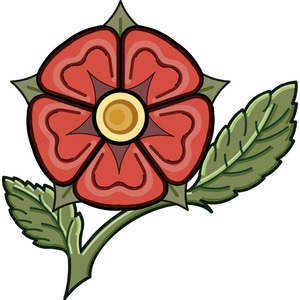
A rose Gules slipped Vert from the Arms of Robert Cheisley of Dalry, who served as Lord Provost in 1694. The Cheisley family’s former mansion house, Dalry House, was built about 1661 and still stands on Orwell Place.
Ward XI
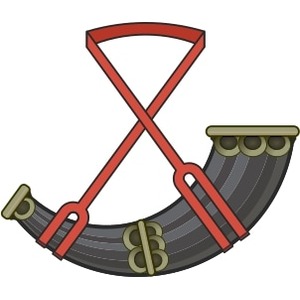
A horn sable garnished Vert stringed Gules from the Arms of Forrester of Corstorphine, a family who maintained lands there from 1360 to the 18th century. Forrester High School is named after the family.
Ward XII
A martlet Azure holding in its beak a star Or. The martlet is taken from the Arms of Murray of Murrayfield, Lord Henderland, who served as solicitor-general of Scotland in 1775. The star is taken from the Arms of the Inglis of Cramond, Baronets between 1660 and 1799.
Ward XIII
A fret Gules from the arms of Sir Hugh McCulloch of Pilton. Before 1672, Hugh McCulloch was known as a writer in Edinburgh. By 1675 he had been knighted. Sir Hugh was laid to rest in Greyfriars kirkyard in Edinburgh.
Ward XIV
A well Proper, being a reference to the neo-classical spring house built near the Water of Leith between Dean Village and Stockbridge.
Ward XV
Two fish in saltire Argent, being a reference to St Andrew, a disciple of Jesus, who was a fisherman when they met.
Ward XVI
A cross crosslet Or from the Arms of Lord William Bellenden of Broughton, a staunch Royalist during the Civil War, who served as Treasurer-depute of Scotland in 1661.
Ward XVII
A telescope reversed Proper, being a reference to the City (or Calton Hill) Observatory established in 1776.
Ward XVIII
A sailing ship Proper, being a reference to the historic Port of Leith which hosted the world-famous Tall Ships’ Race in 1995.
Ward XIX
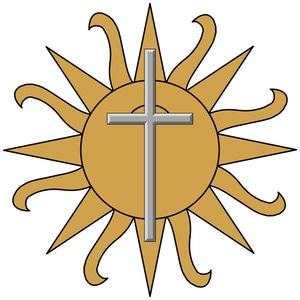
The sun in splendour Or charged with a navigational cross Proper from the Arms of Trinity House. This is a reference to the navigational links of Leith and probably to the popular 1988 ballad “Sunshine on Leith” by the Proclaimers. Leith was merged with Edinburgh in 1920.
Ward XX
Three passion nails conjoined in point Sable from the Arms of Logan of Restalrig, a family who lived at Lochend Castle and many of whom served as Provost of Leith.
Ward XXI
A fox’s mask Proper, being a reference to the area name being a corruption of the gaelic “Creag an t-Sionnaich” meaning “Crag of the Fox”.
Ward XXII
A cannon Sable, taken from the Arms granted to the town in 1886. The Arms are an example of canting heraldry: the ships on the town shield representing the port (Porto) and the cannons, war (Bello).
Ward XXIII
A unicorn’s head from the Arms of Preston of Craigmillar. Known as Edinburgh’s other castle, Craigmillar Castle was famously used as a safe haven in 1566 by Mary Queen of Scots.
Medals and Batons
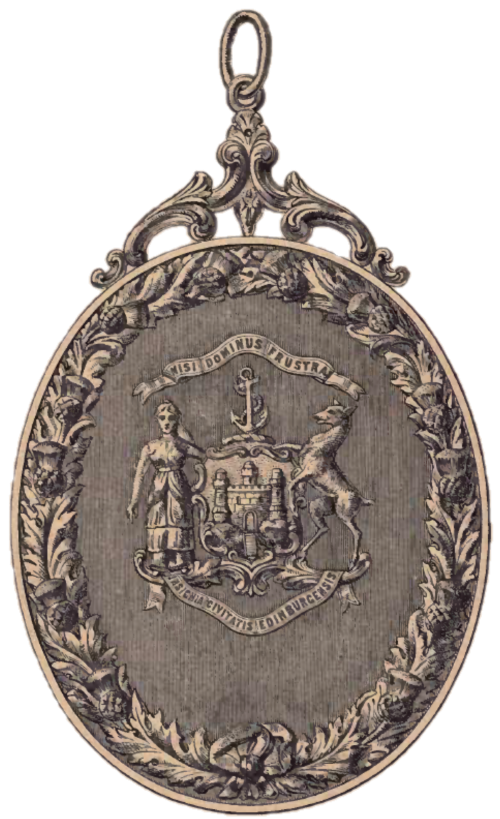
The Moderator wears a medal as his badge of office. As described in Marwick: The History of the High Constables of Edinburgh (1865):
“A Gold Medal with a massive gold link chain, purchased by the Society in 1863. The medal is oval with two richly chased wreaths of Scotch Thistles. On one side are the Edinburgh City Arms, with supporters, crest and motto finely chased; and on the reverse side is an inscription.”
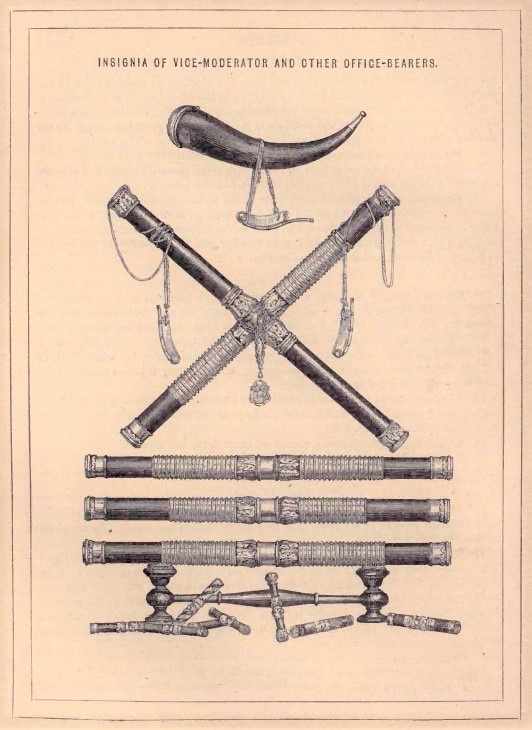
The 19th century saw a large increase in the insignia of the Society. In addition to the Moderator’s gold medal and chain, there is the Vice Moderator’s gold medal from 1865 and various large silver ceremonial batons for the use of office bearers. The silver batons have been inscribed with the names of all office bearers since about 1820.
The oldest artefact is the Treasurer’s brass money box which was made in 1698 and is inscribed with the names and occupations of the constables who contributed to its cost; among other inscriptions is a reference to the part played by Edinburgh High Constables during the visit of Queen Victoria to the City on 1st September 1842.
All Society Regalia is held securely for the Society by the Council of the City of Edinburgh.
Equipment
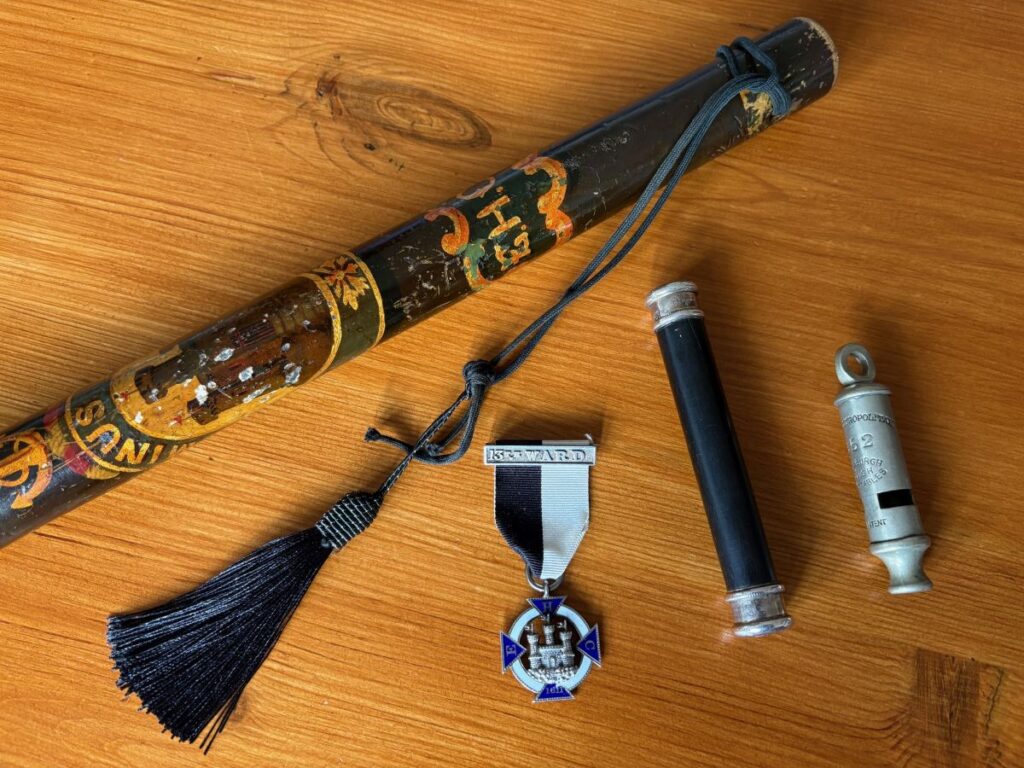
On joining the Society, members are issued with their Society equipment. It is their responsibility to safeguard these items and they must be returned to the Society when membership ceases.
The equipment consists of the Society medal, long wooden baton, short tipstaff baton and patrol whistle. All these items are marked with the Constable number.